
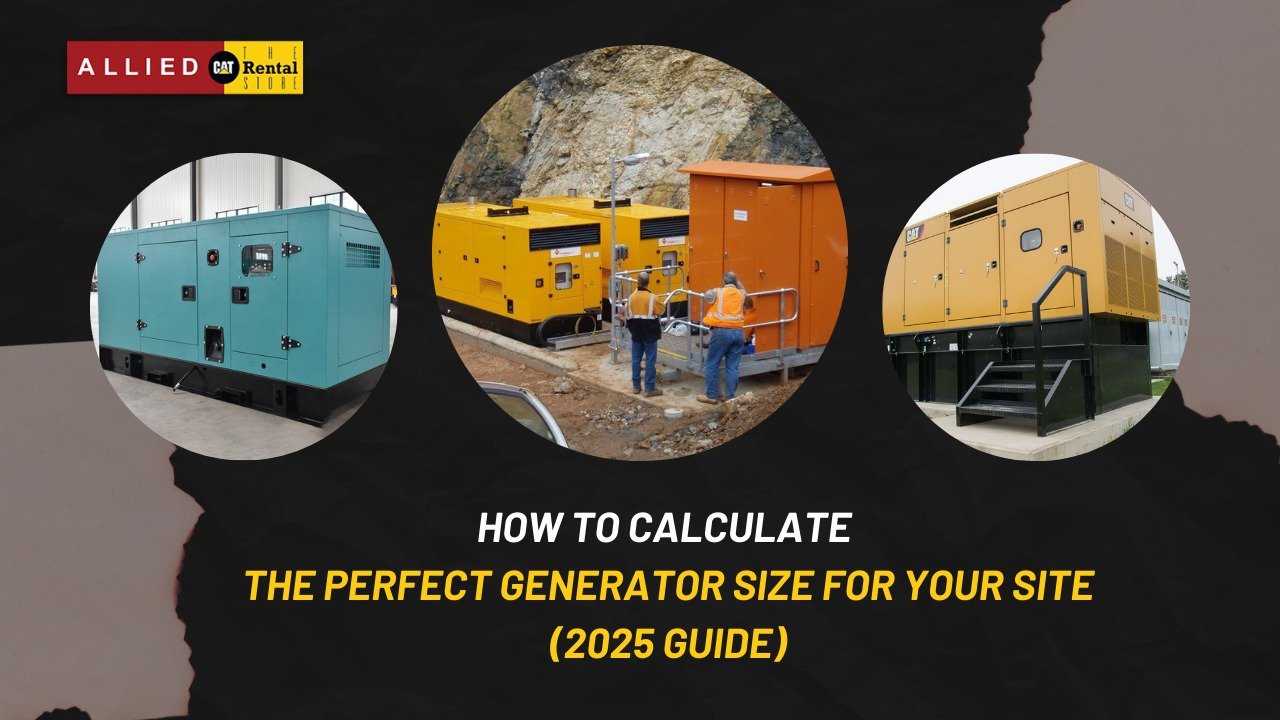
Picture this: You’ve invested in a new generator for your business. The power goes out. You start it up, and… the lights flicker, your machinery groans, and the generator stalls under the load. Alternatively, the generator roars to life effortlessly, but you notice it’s barely breaking a sweat, guzzling fuel inefficiently for a load it was never meant to carry.
Both scenarios are symptoms of the same common mistake: choosing the wrong generator size.
Selecting the right-sized generator isn’t just about having power; it’s about having reliable, efficient, and safe power. An undersized generator can damage your appliances and fail when you need it most. An oversized one wastes fuel, costs more to rent or buy, and can cause long-term engine damage due to “wet stacking.”
This guide will walk you through, step-by-step, how to calculate the perfect generator size for your needs in Pakistan, ensuring you get it right the first time.
The Golden Rule: It’s All About the kW (and kVA)
First, let’s demystify the units you’ll see on every generator: kW (kilowatts) and kVA (kilovolt-amperes).
- kW (Kilowatts): This is the measure of real power—the actual power doing the work, like running your motors, lights, and tools.
- kVA (Kilovolt-Amperes): This is the measure of apparent power—the total power flowing in the circuit.
For simplicity, you can think of it this way: kW is the power you use, kVA is the power the generator supplies. The ratio between them is the power factor (PF), which is typically 0.8 for most standard calculations.
The Magic Formula: kW = kVA × Power Factor (0.8)
So, if a generator is rated at 100 kVA, its real power output is approximately 80 kW. When calculating your needs, we focus on kW because that’s what your equipment consumes.
Step 1: Make a Detailed List of Everything You Need to Power
Grab a notepad. This is the most critical step. You need to list every single appliance, tool, or machine that will run on the generator—simultaneously or in sequence.
For a Construction Site:
- Concrete mixer
- Welding machine
- Electric hammer drills
- Water pumps
- Site office (lights, AC, computer)
- Industrial lights
For a Home or Business:
- Refrigerator + Deep freezer
- Air Conditioner (ACs are big power users!)
- Lights (all bulbs and tubes)
- Fans
- Water pump
- Computer/TV/Router
Step 2: Find the Starting and Running Wattage of Each Item
This is the secret to avoiding the #1 mistake. Many appliances, especially those with electric motors (like ACs, fridges, water pumps), need a massive surge of power to start up—much more than they need to keep running.
You need to find two numbers for each item:
- Running Watts (RWatts): The continuous watts needed to keep the appliance running.
- Starting Watts (SWatts): The extra watts needed for the first few seconds to start the motor.
Where to find these numbers?
- Check the appliance’s nameplate or manual.
- Look for a sticker with “W” (Watts) or “A” (Amps). If you find Amps, use this formula: Watts = Volts × Amps. (In Pakistan, Volts are typically 220V).
Pro Tip: If you can’t find the starting watts, a good rule of thumb is that it can be 2 to 3 times the running watts for motor-driven appliances.
Step 3: Do the Math (The Simple Calculation)
Now, let’s plug the numbers into a simple formula.
- Calculate Total Running Watts: Add up the Running Watts of all appliances that will be running at the same time.
- Account for the Biggest Surge: Identify the appliance with the highest Starting Watts. Add this surge amount to your total running watts.
Total Generator Size Needed = Total Running Watts + Highest Starting Watts
Example: A Small Office
- Lights (10 bulbs): 100W x 10 = 1,000 W (1 kW)
- Fans (4 fans): 75W x 4 = 300 W (0.3 kW)
- 1 HP Water Pump: Running Watts = 750W (0.75 kW), Starting Watts = 1,500W (1.5 kW)
- 1.5 Ton Inverter AC: Running Watts = 1,500W (1.5 kW), Starting Watts = 2,500W (2.5 kW) – This has the highest surge.
Calculation:
- Total Running Watts = 1,000W + 300W + 750W + 1,500W = 3,550 W (3.55 kW)
- Add the Highest Starting Surge (from the AC) = 3,550W + 2,500W = 6,050 W (6.05 kW)
Result: You would need a generator with a capacity of at least 6.5 kW to handle the startup of the AC while everything else is running.
Step 4: Add a Safety Margin (The 20% Rule)
Never run a generator at 100% of its capacity. It strains the engine and leaves no room for error. Always add a safety margin of about 20-25%.
Using our example:
- Required Capacity: 6.05 kW
- Add 20% Safety Margin: 6.05 kW × 1.20 = 7.26 kW
Final Recommendation: A 7.5 kVA or 8 kW generator would be the perfect, safe choice for this office.
The ARSL Advantage: We Do the Math For You
While this guide empowers you to make an informed estimate, nothing beats professional consultation. At ARSL, we take the guesswork out of the equation.
Our experts can:
- Conduct a Site Survey: We’ll visit your location and assess your exact power needs.
- Use Advanced Load Calculators: We employ professional tools to get a precise measurement.
- Recommend the Perfect Fit: We’ll match you with a generator from our extensive fleet that offers the best balance of power, fuel efficiency, and cost for your specific requirements. Whether you need a prime power source for a construction site or a standby generator for your home, we have the right kW solution.
Common Sizing Mistakes to Avoid
- Ignoring Starting Watts: This is the most common and costly error.
- Guessing the Load: “Eyeballing” it rarely works. Always make a list.
- Forgetting Future Expansion: If you plan to add more equipment soon, factor that into your calculation now.
Conclusion: Power with Precision
Choosing the right generator size is a science, not a guessing game. By taking the time to calculate your needs accurately, you invest in reliability, efficiency, and the longevity of your equipment. You ensure that when the grid fails, your operations don’t.
Don’t risk your power supply on an estimate.
Let ARSL’s experts provide you with a precise, no-obligation assessment. We’re here to ensure you get the perfect power solution for your needs.
Contact ARSL today for a free consultation and let us help you calculate the ideal generator size for your home, business, or project.