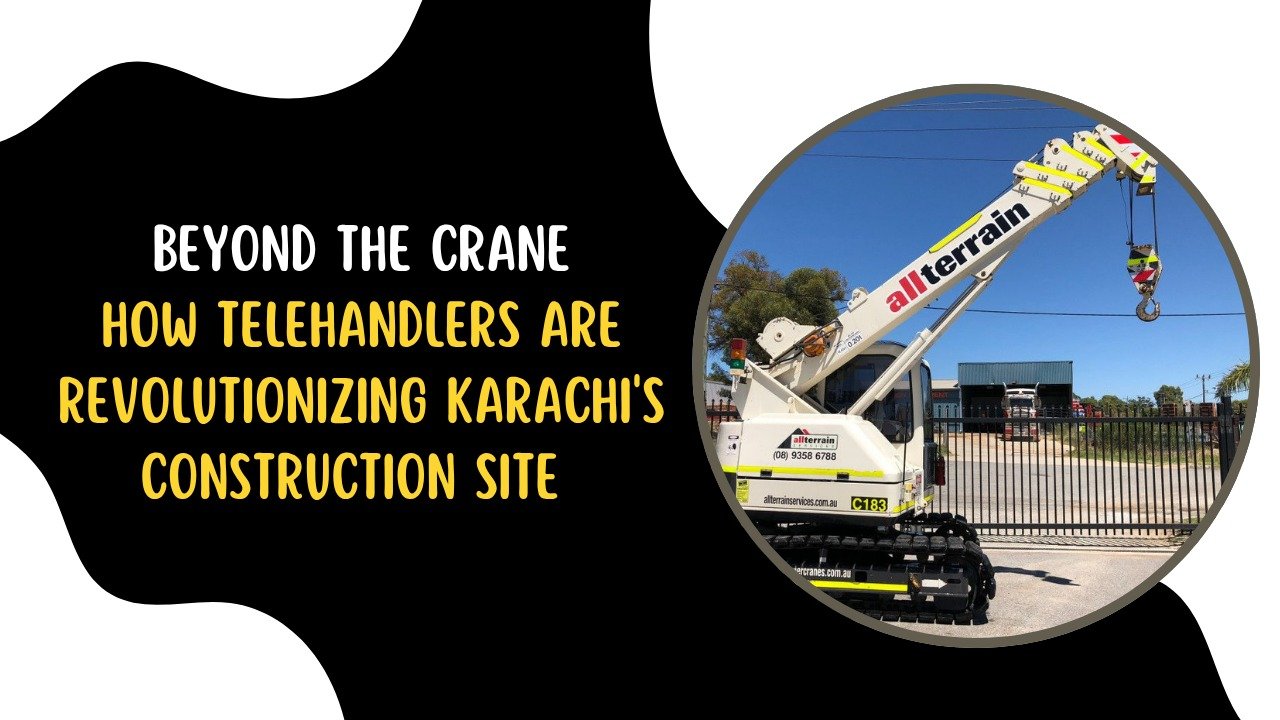
The Skyline of Struggle: Karachi’s Unique Construction Challenges
Look at Karachi’s ever-evolving skyline, and you see a story of ambition. But on the ground, the story is one of complex challenges. Congested sites, narrow access roads, and the relentless pressure of tight deadlines define the daily grind for project managers across the city. For decades, the default solution for lifting and moving materials was the tower crane or the mobile crane. But while essential, cranes have their limitations: they require significant space, setup time, and often can only serve a single purpose.
But what if there was a machine that combined the lifting power of a crane with the mobility and versatility of a forklift? Enter the telehandler – the unsung hero that is quietly revolutionizing how Karachi builds.
What Exactly is a Telehandler? The “Swiss Army Knife” of the Site
Imagine a rugged, all-terrain vehicle with a telescopic boom that can extend forward and upwards. It can lift a pallet of bricks, place a bundle of roofing sheets on the third floor, or even act as a mobile work platform. This is the telehandler.
Often mistaken for a simple forklift, the telehandler is in a league of its own. Its key differentiator is the telescopic boom, which allows it to reach over obstacles and place loads with precision in places a traditional forklift could never go. At the heart of this powerful machine is a robust engine, its capability measured in kW, which provides the muscle for both powerful lifting and excellent ground mobility. This combination of kW power and versatile design is what makes it a game-changer.
Why Telehandlers are a Perfect Fit for Karachi’s Concrete Jungle
The traditional construction site is changing, and the telehandler is leading the charge. Here’s why it’s becoming the go-to equipment choice in a city like Karachi:
1. Unmatched Versatility on a Single Platform
A single telehandler can replace multiple machines. Need to unload a truck? It’s a forklift. Need to place concrete blocks on a higher floor? It’s a crane. Need to get workers to a hard-to-reach spot for repairs? Fit it with a work platform, and it’s a manlift. This multi-functionality is a massive advantage on space-constrained Karachi sites where there’s no room for a fleet of single-purpose machines.
2. Superior Maneuverability in Tight Spaces
Unlike large cranes that require a substantial footprint and setup time, a telehandler is highly mobile. Its compact design and multi-wheel drive allow it to navigate through narrow alleyways and around crowded sites with ease. This agility means less time moving equipment around and more time getting work done.
3. Power and Reach: The Best of Both Worlds
Don’t let its size fool you. Modern telehandlers are powerhouses. The high-torque kW engines allow them to handle substantial loads, often several tons, and place them at significant heights and reaches. This makes them ideal for a wide range of tasks, from steel erection to material handling on mid-rise buildings, tasks that would traditionally require a much larger and more expensive crane.
4. The Economics of Efficiency
For project managers, the bottom line is everything. Renting or operating a large crane is a significant expense. A telehandler offers a more cost-effective solution for a majority of lifting tasks. Its ability to perform multiple roles reduces the need for renting several different machines, leading to substantial cost savings on equipment, fuel, and operator manpower.
Telehandler vs. Crane: Choosing the Right Tool for the Job
This isn’t to say that traditional cranes are obsolete. They are still indispensable for ultra-heavy lifts and skyscraper construction. The key is understanding the strengths of each.
Choose a Traditional Crane for:
- Lifting extremely heavy loads (e.g., pre-cast concrete panels, large HVAC units).
- Projects requiring lifts to extreme heights on very tall structures.
- Sites with ample, dedicated space for setup and operation.
Choose a Telehandler for:
- The vast majority of day-to-day material handling tasks.
- Projects with limited or confined space.
- Jobs that require a single machine to perform multiple functions (lifting, placing, reaching).
- Situations where speed, mobility, and versatility are more critical than sheer lifting capacity.
In essence, the telehandler handles the “everyday” lifts with agile efficiency, freeing up larger cranes for the specialized, monumental tasks they are built for.
Powering Progress: The Role of Robust kW Machinery
The performance of a telehandler hinges on its engine. The kW rating is a direct indicator of its power and capability. A machine with a robust kW output ensures:
- Strong Lifting Capacity: Enough power to handle heavy loads without straining the engine.
- Smooth Operation: Consistent power delivery for precise control when placing delicate loads.
- Reliability on Tough Terrain: The torque needed to navigate the uneven, often challenging ground conditions of a construction site.
When considering a telehandler for your project, its kW rating is a crucial spec to evaluate, as it directly impacts its productivity and suitability for the job. For projects where a telehandler isn’t the right fit, ARSL offers a comprehensive range of traditional cranes and other powerful construction machinery to meet every need.
The Future is Versatile: Are You Ready to Rethink Your Site?
The adoption of telehandlers in Karachi is more than a trend; it’s a shift towards smarter, more agile, and more cost-effective construction. It represents a move beyond relying solely on traditional methods and embracing innovation that directly addresses local challenges.
At ARSL, we are at the forefront of this equipment revolution. We understand the unique demands of building in Pakistan’s urban landscapes. That’s why our modern rental fleet includes a range of powerful, reliable telehandlers, ready to deploy to your site and demonstrate their transformative potential.
Ready to see how a telehandler can revolutionize your next project in Karachi? Contact the ARSL team today for a consultation and discover the right power solution, measured in kW, for your construction needs.